
Year 11 Pythagoras Worksheets (GCSE) | Printable PDFs
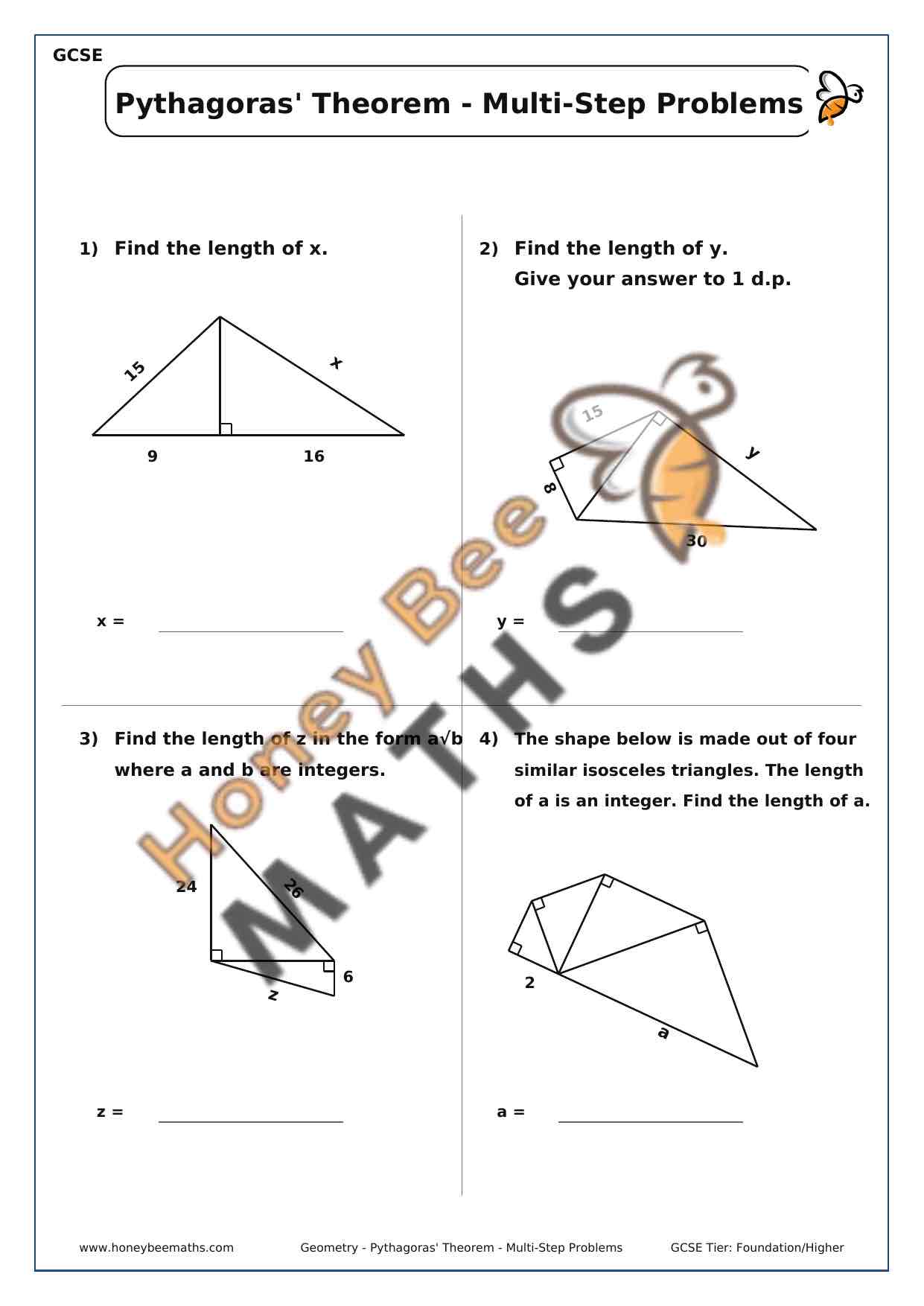
Year 11 Pythagoras worksheets for Year 11 Maths (Key Stage 4, GCSE). In Year 11 Pythagoras, students build on their understanding of Pythagoras’ Theorem to solve more challenging problems involving right-angled triangles. This includes finding missing side lengths, working with multi-step problems, calculating the area of triangles, and applying Pythagoras in 3D shapes. Students may also need to give answers in exact surd form and combine Pythagoras with other areas of GCSE geometry.
These Year 11 Pythagoras worksheets are designed to develop confidence with higher-level GCSE questions and problem solving. Students who would like to revise the core skills first can also use our Year 10 Pythagoras worksheets, which provide practice with the fundamental techniques needed before progressing to more advanced Year 11 questions.


For more Pythagoras Worksheets, see Year 10 Pythagoras Worksheets
Common Questions about Year 11 Pythagoras
What is Pythagoras’ Theorem?
Pythagoras’ Theorem states that in a right-angled triangle, the square of the hypotenuse is equal to the sum of the squares of the other two sides. It can be written as a² + b² = c², where c is the hypotenuse.How is Pythagoras used in Year 11 maths?
In Year 11, Pythagoras is used in more advanced problems including multi-step questions, 3D shapes, finding perpendicular heights, calculating areas and volumes, and solving problems where answers may need to be left in exact surd form.Why is Pythagoras an important GCSE topic?
Pythagoras is important because it is used throughout GCSE geometry and can be combined with trigonometry, area, volume and 3D problem solving. Students need to recognise when a right-angled triangle can be formed and apply the theorem accurately.
Year 11 Pythagoras Common Mistakes
Common Mistake 1
Students sometimes use Pythagoras on triangles that are not right-angled. Always check that the triangle contains a 90° angle before using the theorem.Common Mistake 2
A common mistake is treating the hypotenuse like one of the shorter sides. The hypotenuse is always the side opposite the right angle and is the longest side of the triangle.Common Mistake 3
Students may forget to square the side lengths, use the wrong operation when finding a shorter side, or round too early. Keep exact values for as long as possible and only round at the final stage if required.
Pythagoras Worksheets - Free Worksheets Above

3D Pythagoras (A)

3D Pythagoras (B)

Pythagoras Regular Hexagons